“For World Peace, Stop the War in the Home”
 Gurudeva holding the U Thant Peace Award in front of the United Nations building
- In the hall for the Millennium Summit of spiritual leaders
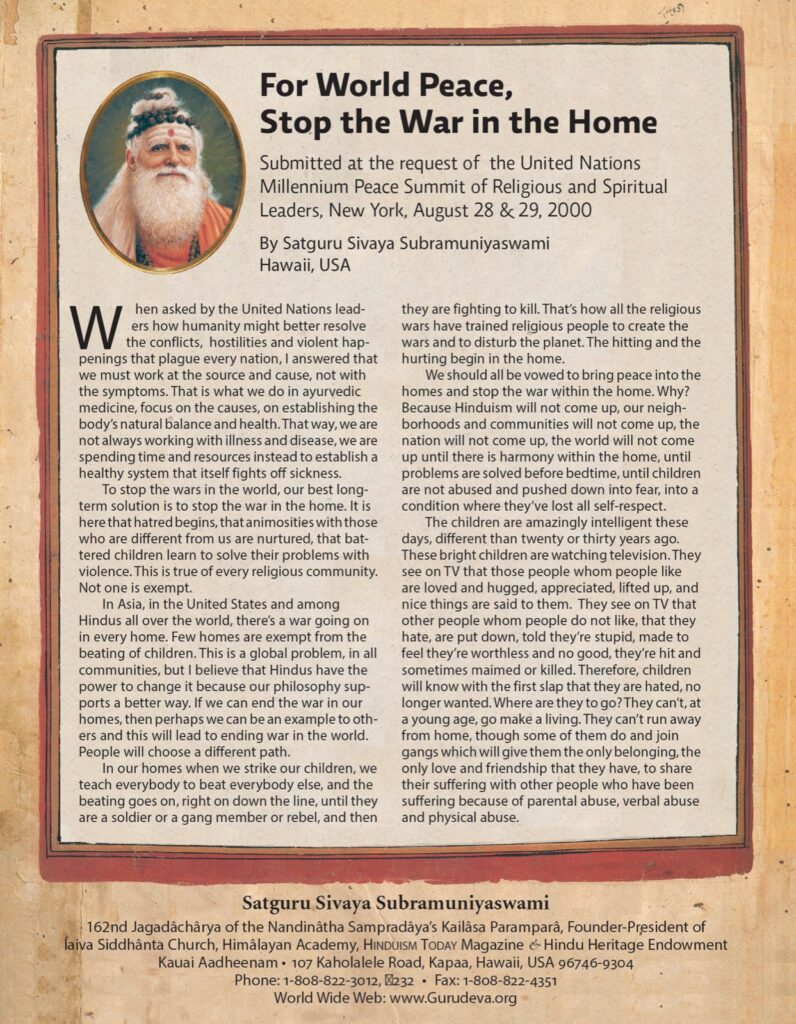
- The message Gurudeva had placed on every delegate’s chair.
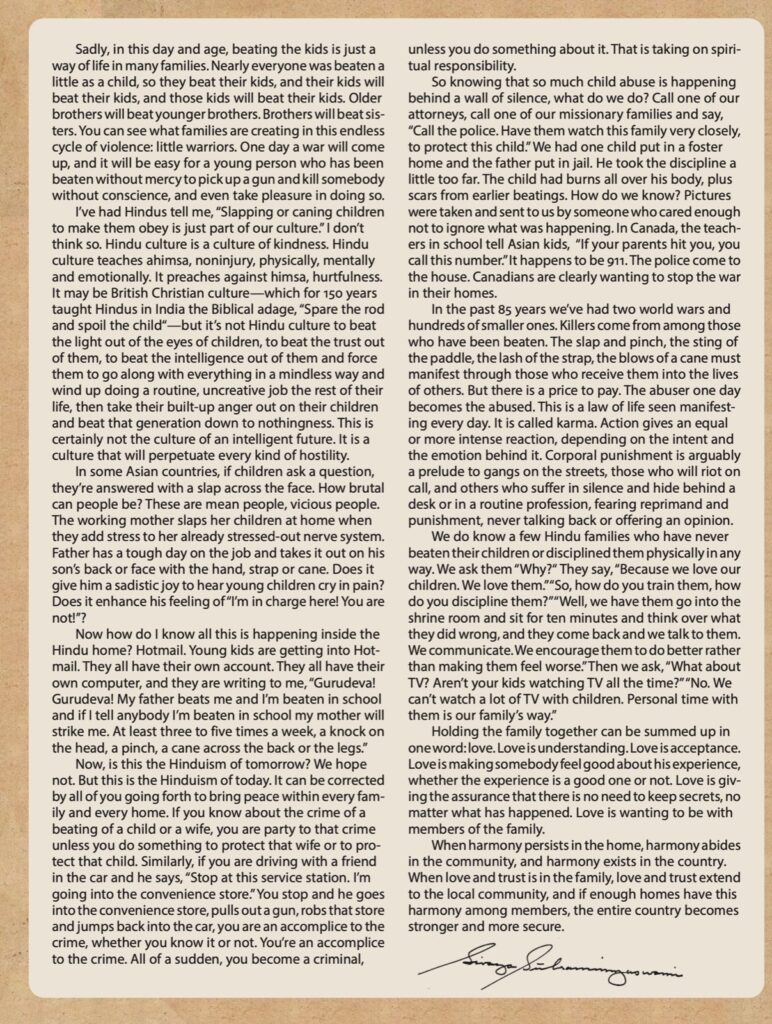
- Page two
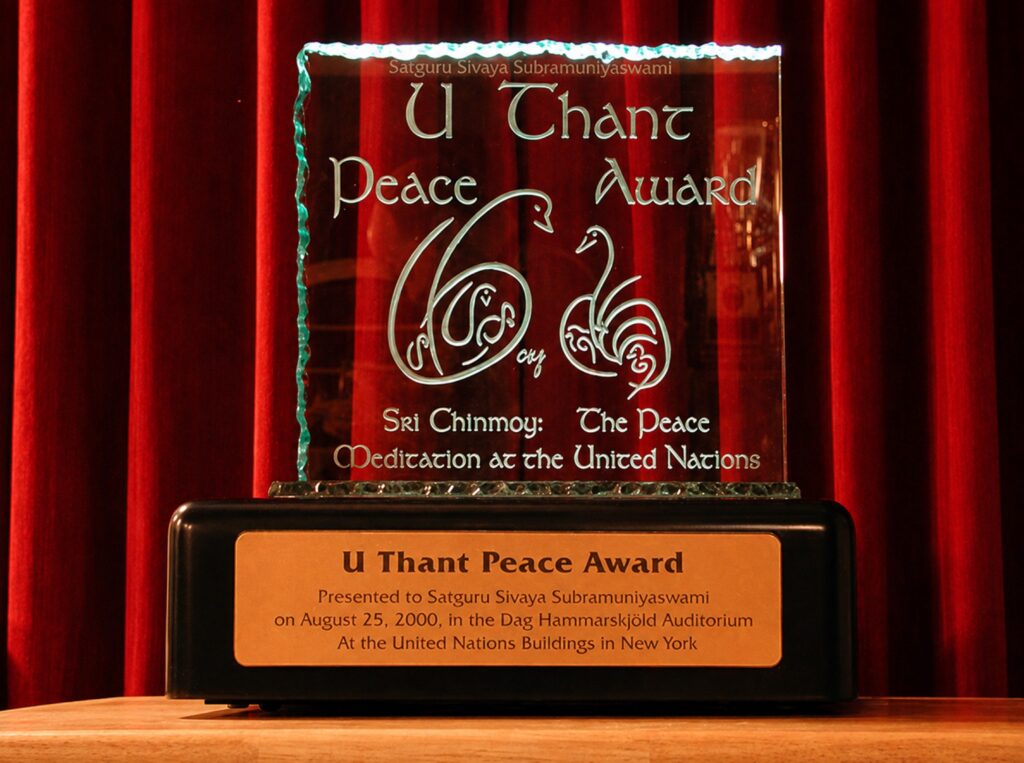
- The award Gurudeva received in New York.
- Standing at the iconic row of flags.
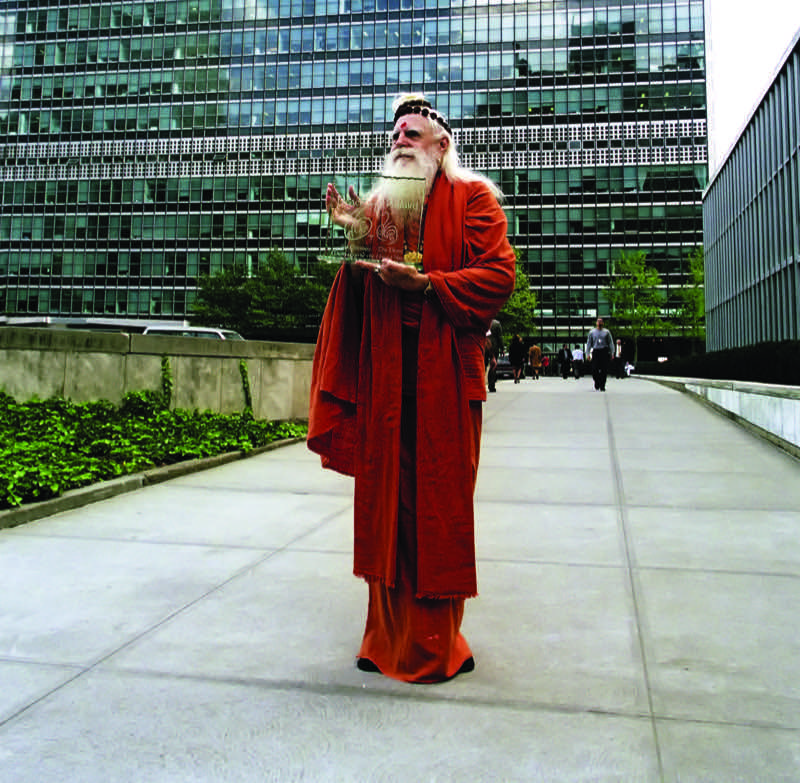
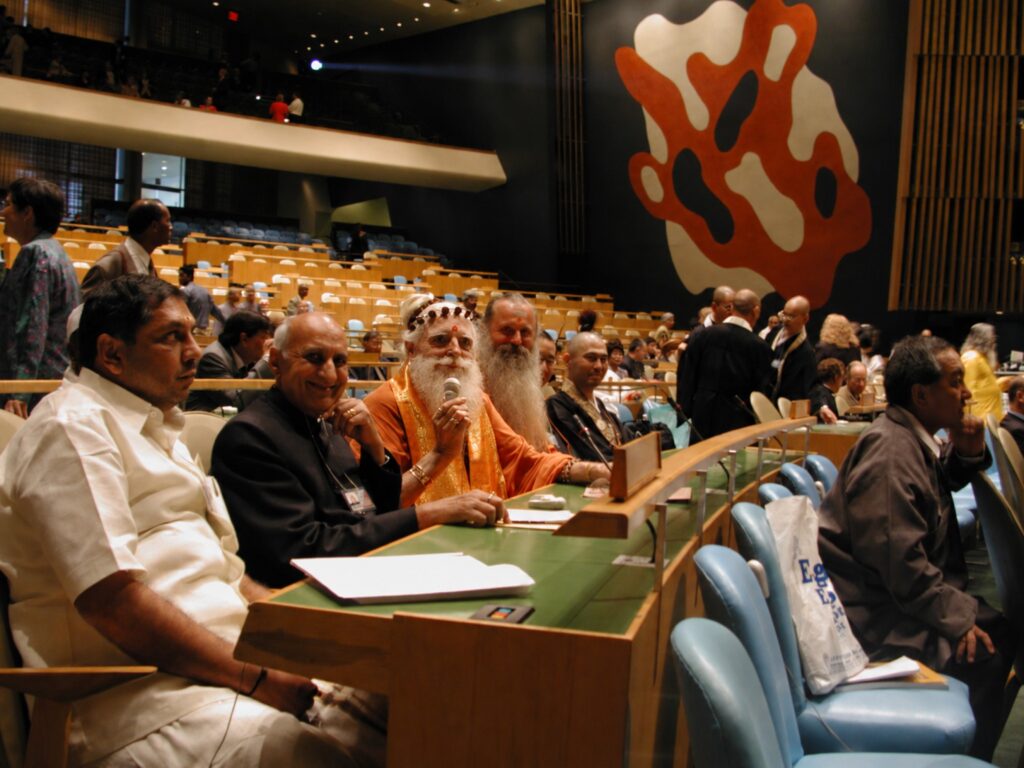
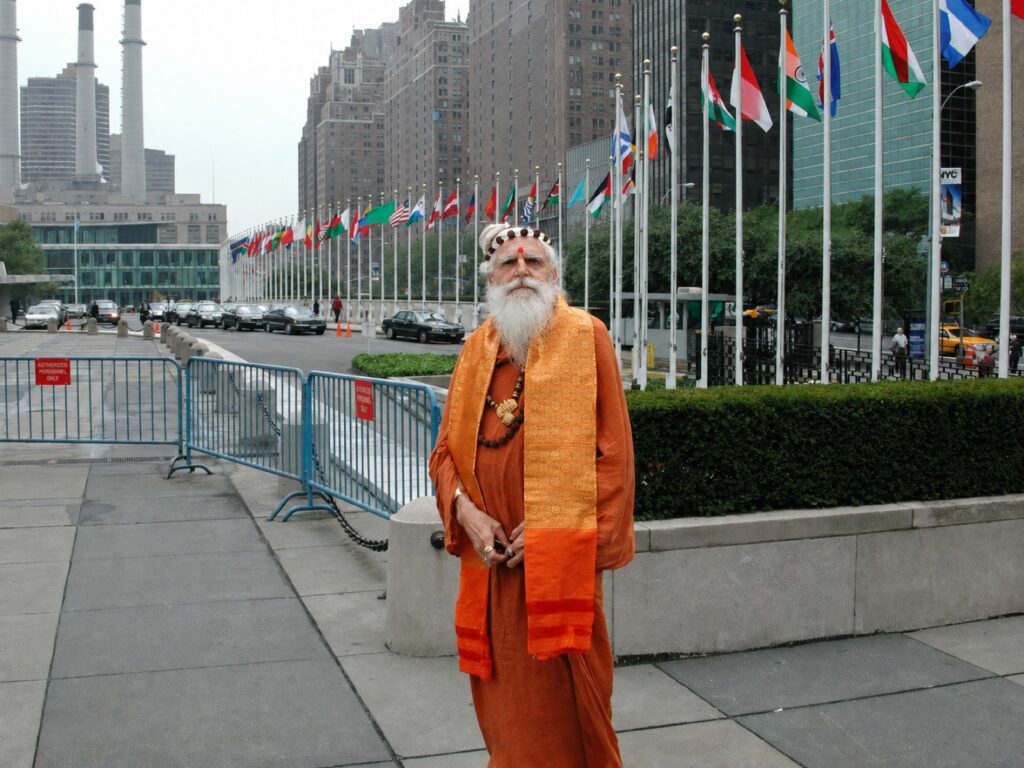
As we draw closer to January 5, 2027, we will be visiting some of Gurudeva’s life and adventures, all in celebration of the fact that 100 years have passed since his birth. Today we go back to August of the year 2000, when he was at the United Nations for something they called The Millennium Summit of Religious and Spiritual Leaders. It was the first time that a faith gathering was the main event in the United Nations General Assembly Hall.
As part of the event, 1,200 delegates met at the nearby Waldorf-Astoria Hotel during which Gurudeva gave his resounding speech, “For World Peace, Stop the War in the Home.” It was a bold challenge to the common political strategy for peace, going as it did to the source of discord, for it is in the home that every child learns who are the friends and who are the enemies. Here, in childhood, otherness is inculcated, hatred is kindled and violent solutions are discussed. What if every child in every faith and nation learned another way?
Gurudeva had his monks place the talk (exactly as you see it in the gallery) on all 1,200 seats in the hall, so the delegates would take home every word. It was a beautiful moment. That week he also received the U Thant Peace Award for his life’s work bringing harmony to the world, especially among various faiths.
Enjoy reading the speech. Pass it along. His message is so needed in today’s cacophony of conflict.
Here is the talk in shareable form.
For World Peace,
Stop the War in the Home
Submitted at the request of the United Nations Millennium Peace Summit
of Religious and Spiritual Leaders
New York, August 28 & 29, 2000
By Satguru Sivaya Subramuniyaswami
Hawaii, USA
When asked by the United Nations leaders how humanity might better resolve the conflicts, hostilities and violent happenings that plague every nation, I answered that we must work at the source and cause, not with the symptoms. That is what we do in ayurvedic medicine, focus on the causes, on establishing the body’s natural balance and health. That way, we are not always working with illness and disease, we are spending time and resources instead to establish a healthy system that itself fights off sickness.
To stop the wars in the world, our best long-term solution is to stop the war in the home. It is here that hatred begins, that animosities with those who are different from us are nurtured, that battered children learn to solve their problems with violence. This is true of every religious community. Not one is exempt.
In Asia, in the United States and among Hindus all over the world, there’s a war going on in every home. Few homes are exempt from the beating of children. This is a global problem, in all communities, but I believe that Hindus have the power to change it because our philosophy supports a better way. If we can end the war in our homes, then perhaps we can be an example to others and this will lead to ending war in the world. People will choose a different path.
In our homes when we strike our children, we teach everybody to beat everybody else, and the beating goes on, right on down the line, until they are a soldier or a gang member or rebel, and then they are fighting to kill. That’s how all the religious wars have trained religious people to create the wars and to disturb the planet. The hitting and the hurting begin in the home.
We should all be vowed to bring peace into the homes and stop the war within the home. Why? Because Hinduism will not come up, our neighborhoods and communities will not come up, the nation will not come up, the world will not come up until there is harmony within the home, until problems are solved before bedtime, until children are not abused and pushed down into fear, into a condition where they’ve lost all self-respect.
The children are amazingly intelligent these days, different than twenty or thirty years ago. These bright children are watching television. They see on TV that those people whom people like are loved and hugged, appreciated, lifted up, and nice things are said to them. They see on TV that other people whom people do not like, that they hate, are put down, told they’re stupid, made to feel they’re worthless and no good, they’re hit and sometimes maimed or killed. Therefore, children will know with the first slap that they are hated, no longer wanted. Where are they to go? They can’t, at a young age, go make a living. They can’t run away from home, though some of them do and join gangs which will give them the only belonging, the only love and friendship that they have, to share their suffering with other people who have been suffering because of parental abuse, verbal abuse and physical abuse.
Sadly, in this day and age, beating the kids is just a way of life in many families. Nearly everyone was beaten a little as a child, so they beat their kids, and their kids will beat their kids, and those kids will beat their kids. Older brothers will beat younger brothers. Brothers will beat sisters. You can see what families are creating in this endless cycle of violence: little warriors. One day a war will come up, and it will be easy for a young person who has been beaten without mercy to pick up a gun and kill somebody without conscience, and even take pleasure in doing so.
I’ve had Hindus tell me, “Slapping or caning children to make them obey is just part of our culture.” I don’t think so. Hindu culture is a culture of kindness. Hindu culture teaches ahimsa, noninjury, physically, mentally and emotionally. It preaches against himsa, hurtfulness. It may be British Christian culture—which for 150 years taught Hindus in India the Biblical adage, “Spare the rod and spoil the child”—but it’s not Hindu culture to beat the light out of the eyes of children, to beat the trust out of them, to beat the intelligence out of them and force them to go along with everything in a mindless way and wind up doing a routine, uncreative job the rest of their life, then take their built-up anger out on their children and beat that generation down to nothingness. This is certainly not the culture of an intelligent future. It is a culture that will perpetuate every kind of hostility.
In some Asian countries, if children ask a question, they’re answered with a slap across the face. How brutal can people be? These are mean people, vicious people. The working mother slaps her children at home when they add stress to her already stressed-out nerve system. Father has a tough day on the job and takes it out on his son’s back or face with the hand, strap or cane. Does it give him a sadistic joy to hear young children cry in pain? Does it enhance his feeling of “I’m in charge here! You are not!”?
Now how do I know all this is happening inside the Hindu home? Hotmail. Young kids are getting into Hotmail. They all have their own account. They all have their own computer, and they are writing to me, “Gurudeva! Gurudeva! My father beats me and I’m beaten in school and if I tell anybody I’m beaten in school my mother will strike me. At least three to five times a week, a knock on the head, a pinch, a cane across the back or the legs.”
Now, is this the Hinduism of tomorrow? We hope not. But this is the Hinduism of today. It can be corrected by all of you going forth to bring peace within every family and every home. If you know about the crime of a beating of a child or a wife, you are party to that crime unless you do something to protect that wife or to protect that child. Similarly, if you are driving with a friend in the car and he says, “Stop at this service station. I’m going into the convenience store.” You stop and he goes into the convenience store, pulls out a gun, robs that store and jumps back into the car, you are an accomplice to the crime, whether you know it or not. You’re an accomplice to the crime. All of a sudden, you become a criminal, unless you do something about it. That is taking on spiritual responsibility.
So knowing that so much child abuse is happening behind a wall of silence, what do we do? Call one of our attorneys, call one of our missionary families and say, “Call the police. Have them watch this family very closely, to protect this child.” We had one child put in a foster home and the father put in jail. He took the discipline a little too far. The child had burns all over his body, plus scars from earlier beatings. How do we know? Pictures were taken and sent to us by someone who cared enough not to ignore what was happening. In Canada, the teachers in school tell Asian kids, “If your parents hit you, you call this number.” It happens to be 911. The police come to the house. Canadians are clearly wanting to stop the war in their homes.
In the past 85 years we’ve had two world wars and hundreds of smaller ones. Killers come from among those who have been beaten. The slap and pinch, the sting of the paddle, the lash of the strap, the blows of a cane must manifest through those who receive them into the lives of others. But there is a price to pay. The abuser one day becomes the abused. This is a law of life seen manifesting every day. It is called karma. Action gives an equal or more intense reaction, depending on the intent and the emotion behind it. Corporal punishment is arguably a prelude to gangs on the streets, those who will riot on call, and others who suffer in silence and hide behind a desk or in a routine profession, fearing reprimand and punishment, never talking back or offering an opinion.
We do know a few Hindu families who have never beaten their children or disciplined them physically in any way. We ask them “Why?” They say, “Because we love our children. We love them.” “So, how do you train them, how do you discipline them?” “Well, we have them go into the shrine room and sit for ten minutes and think over what they did wrong, and they come back and we talk to them. We communicate. We encourage them to do better rather than making them feel worse.” Then we ask, “What about TV? Aren’t your kids watching TV all the time?” “No. We can’t watch a lot of TV with children. Personal time with them is our family’s way.”
Holding the family together can be summed up in one word: love. Love is understanding. Love is acceptance. Love is making somebody feel good about his experience, whether the experience is a good one or not. Love is giving the assurance that there is no need to keep secrets, no matter what has happened. Love is wanting to be with members of the family.
When harmony persists in the home, harmony abides in the community, and harmony exists in the country. When love and trust are in the family, love and trust extend to the local community, and if enough homes have this harmony among members, the entire country becomes stronger and more secure.
“For World Peace, Stop the War in the Home” Read More »